Previous Story
WCHS students getting valuable career certifications
Posted On 16 Sep 2021
Comment: 0
High school isn’t what it used to be when most people who are 50 and older attended it, or even many folks now in their 40s or even 30s. Some students are now graduating high school with the ability to enter the work force already certified in a field and able to start a career.

Gena McCubbins, chief operating officer for Dataseam, presented Pierce Bowlin with this new laptop during a recent meeting.
During last Thursday’s monthly meeting, the Whitley County Board of Education board recognized a high school junior, who is already working for the school district doing information technology (IT) support, and it recognized six students, who graduated last year with certifications in the medical field.
Gena McCubbins, chief operating officer for Dataseam, which is a non-profit company out of Louisville, presented Pierce Bowlin with a new laptop as part of his internship with the district.
This is a first of its kind program involving the Kentucky Appalachian Regional Commission (ARC) and the Department of Labor for an IT apprenticeship partnership.
“We have one student that was selected from Whitley County to be a part of the program,” McCubbins said. “The federal grant that we applied for, for this apprenticeship is one of 176 applications. It is the first program of its kind in Kentucky and the 13 ARC states.”
The program is a two-year program beginning in a student’s junior year in high school that is done in three phases in a skilled trade, in this case information technology (IT).
Bowlin will work alongside Kevin Anderson, who is the chief information officer for the Whitley County School District, getting on the job training.
Statewide, there are a total of 29 apprentices in 20 counties.
“He will graduate with two certifications, and he can enter the work force making anywhere from $65,000 – $100,000 per year for an IT professional job,” McCubbins said.
Currently, there are 32,000 open jobs in Kentucky paying about 76 percent higher than the national average for the same job. COVID-19 has created a 60 percent increased demand, McCubbins added.
IT jobs are available in healthcare, banking, government and schools in addition to other groups needing IT professionals.
Anderson added that Whitley County was one of two counties that were part of the original pilot project for this program, which involved a partnership between the school district and Dataseam to provide internships to students while still in high school.
“I am excited that it has caught on, and grown and spread across the state. Our previous students have gone on to be very successful,” he said.
Over the past summer, the district installed several new interactive panels, added several new computers, and document cameras in addition to Chromebooks.
“We had a previous apprentice come back and work for us over the summer,” Anderson added. “The work experience that we can provide for these folks. It really helped them and will help Pierce in the future.”
Dataseam is an organization that does cancer research in conjunction with the University of Louisville, and has provided the district with over $740,000 worth of Macintosh computers over the last 15 years.
By day, students use the machines for classwork and at night, Dataseam and the University of Louisville, use the processing power of those machines to help do cancer research.

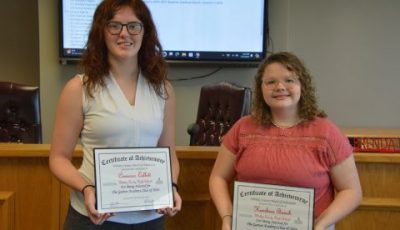
The Whitley County Board of Education presented white coats to Breanna Fox, Kara Helton, Katie Adkins, Kenzie Fields, and Katy Powers during a recent meeting. Victoria Wohlfarth also earned a white coat, but couldn’t be present for the meeting.
In addition, the board also held a white coat ceremony for some recently graduated students, who completed healthcare related certifications.
The board presented white coats to Katie Adkins, Kenzie Fields, Katy Powers and Victoria Wohlfarth, who couldn’t be at the meeting, for earning their certifications as phlebotomy technicians.
The board also presented white coats to Breanna Fox and Kara Helton for their certification as patient care technicians.
Phlebotomy technicians work in hospitals, diagnostic laboratories and blood donor centers by drawing blood from patients and blood donors, explain the blood drawing process to them, and can perform basic point-of-care testing, such as reading blood glucose levels.
Phlebotomy technicians can also prepare blood, urine and other specimens for testing, and maintain medical equipment, such as needles, test tubes and blood vials.
Each student must perform 30 successful venipunctures and 10 successful capillary sticks on live individuals to get their certification.
Patient care technicians assist doctors, nurses and other healthcare professionals with the critical day-to-day care some patients require, such as bathing, feeding, catheter care, distributing patient care supplies, and performing safety checks and ensuring the cleanliness in patient rooms.
They can also obtain EKG readings, monitor vital signs, perform phlebotomy procedures, and provide emotional support to patients and families, particularly those coping with grief and death.
Superintendent John Siler noted that upon completion of their certifications, any of these six students could now go out and get jobs in their respective fields. Most are now attending college majoring in a healthcare related field, such as nursing.