Previous Story
Former NYPD detective could soon find out whether 9/11 Victims’ Fund gets expanded to include rare kidney disease
Posted On 03 Jul 2022
Comment: 0
New York City police detective Rich Volpe was one of thousands of first responders, who rushed to ground zero on the morning of Sept. 11, 2001, after terrorists destroyed the World Trade Center towers.

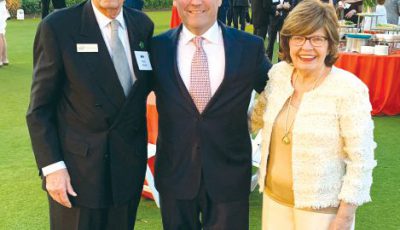
Former NYPD Detective Rich Volpe met with Terry and Marion Forcht at the Club for Growth Winter Economic Conference in 2020. Volpe discussed his fight against a rare kidney disease that he developed following his work in the wake of the 9/11 terrorist attacks in New York. He will soon find out whether the fund, which is set up to aid first responders who became ill after working at ground zero, will cover his disease and provide him compensation. So far, it has not.
He spent the first five minutes mentally processing the 50-story high twisted pieces of steel and other debris trying to figure out, if what he was seeing was even real.
He had to take a dust pan to sweep out the bottom of his bathtub after showering a day or so later because there had been so much dust and debris that washed off his body.
Volpe then spent the next nine months along with other officers at an old Stanton Island landfill combing through a mountain of debris looking for human remains from ground zero ruble, which had been trucked there. The stack was so large that it was as high as the Statue of Liberty.
When he later got sick, Volpe didn’t get cancer or any number of lung diseases like many ground zero first responders did. Instead, it was something much rarer.
In June 2003, Volpe was diagnosed with IgA Nephropathy. In essence, the disease shuts down the little filters in the kidneys that remove toxins from your body.
“I never knew until this happened how important your kidneys were,” Volpe said. “I lost both my kidneys from all the toxins down there.”
Within one year of his diagnosis, Volpe had lost about 60 percent of his kidney function. He had a kidney transplant in 2014.
His doctor in New York knew almost immediately that the rare disease, which normally affects people in their 50’s and 60’s, was related to Volpe’s 9/11 work. Volpe was only 33 years old at the time, and was eventually forced to retire after working only 13 years.
Trying to convince the federal government his disease was caused by exposure to ground zero debris has been an entirely different matter though.
In the ensuing years after 9/11, Volpe was among the list of more than 20,000 9/11 first responders, volunteers and survivors, who fell ill from the toxic dust and fumes from ground zero.
In 2020, Congress approved $10.2 billion in funding for September 11th Victim Compensation Fund to help cover medical claims from ground zero workers.
Volpe noted that fund picks and chooses what diseases and illnesses that it covers. This includes pretty much all cancer and breathing difficulties, but kidney and liver issues are another thing.
The law and its funding have helped a lot of Volpe’s friends and co-workers, but as it stands now, it hasn’t helped him, but that could soon be changing.
In 2018, Dr. Mary Ann McLaughlin contacted Volpe to be part of a study by the Icahn School of Medicine at Mount Sinai in New York, which was looking at the effects of 9/11 on kidney disease.
“There were two other guys that I worked with down at ground zero, who had the same exact disease. We all went into kidney failure at the same time and we all had kidney transplants at the same time. She didn’t think that was a coincidence,” Volpe noted. “IgA, it is very rare that you actually go into kidney failure. It is even more rare that you actually have a kidney transplant. She started looking into it and started doing a study,” Volpe noted.
It is estimated that only about 60,000 people in the United States have IgA Nephropathy, according to the National Kidney Foundation.
The study was recently completed, and is waiting to be published. After the results are published, the results will then be presented to the World Trade Center Health Program (WTCHP), which certifies and treats coverable conditions for those impacted by the collapse of the World Trade Center, for review to see if Volpe’s kidney disease will be recognized as one of the illnesses covered.
There are only about a dozen people from the study, who developed IgA, whose cases are being presented.
“This is like the first and only shot we are going to get for any kind of compensation,” Volpe added.
The fund recently added uterine cancer as one of the diseases covered. This is significant as it is the first time since the pandemic struck that a new disease or illness has been added.
“We are hoping they are going to start adding diseases again,” he noted.