Previous Story
Corbin woman remembers her two children, who died from fatal overdoses during overdose awareness walk
Dorthy Baker came to NIBROC Park in Corbin Monday night and placed purple ribbons bearing the names of her two children, Aaron Keasler and Pauline Kramer.

Dorthy Baker placed ribbons in NIBROC Park Monday evening in remembrance of her two children, Aaron Keasler and Pauline Kramer, who both died from drug overdoses. The Whitley County Health Department held a drug awareness walk Monday.
Baker said Keasler was 20 when he died of a morphine overdose, while Kramer was a week away from her 23rd birthday when she overdosed on methadone.
“The pain from losing them is just horrible,” Baker said. “It is really a road that I wouldn’t wish upon my worst enemy.”
Joining Baker was Trisha Mills, who added several ribbons for friends she met while she was going through recovery and for family members.
“Some were people who I knew my whole life,” Mills said.
Baker said what makes it even harder is  watching someone you love and care about go through the addiction.
“It’s horrible because until they make a decision to get help, there is nothing you can do for them,” Baker said.
While almost everyone knows someone, who has suffered from addiction, knowing someone who has died from a drug overdose is not something everyone can relate to.
“It is kind of like seeing someone die from  cancer,” Baker said when asked to describe the feeling.
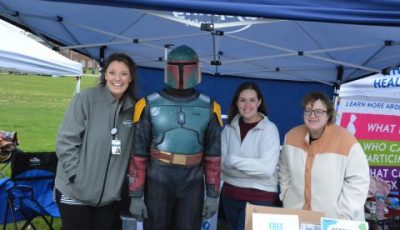
The purple ribbons were part of the Overdose Awareness Walk that the Whitley County Health Department organized as part over International Overdose Awareness Day.
Health Department Director Marcy Rein said that despite the rain and COVID–19 the turnout was good with more than 60 people taking part with approximately 30 ribbons bearing the names of victims of overdose being set up at the park.
“A big piece of what we are doing is
 awareness that there are overdoses in the community and that they are preventable,” Rein said.
In addition to the ribbons, organizers offered a number of resources from information on treatment facilities to the use of NARCAN to reverse an opioid overdose.
“We had 43 people participate in the training,” Rein said noting it is distributed through the harm reduction clinics.
A chalkboard was also set up for those in attendance to offer suggestions on how to fight the increasing number of drug overdoses.
Rein said the suggestions including the community not ignoring the problem, and making an effort to eliminate the stigma.
Rein reiterated that it is up to the addicts to decide they want help before they can take the next step in recovery.
However, when a person does so, the health department can aid in that effort.
“We have a case manager who can help coordinate that for those having trouble or who don’t know where to start,” Rein said explaining that Operation UNITE has a voucher program to help cover the cost of treatment, while others may be covered through their health insurance or Medicaid.
In addition, the health department hosts a harm reduction clinic every Friday in Williamsburg.
The clinic offers access to services, education and safety measures, including a needle exchange and testing for Hepatitis and HIV.
More information is available by contacting the health department at 549-3380.